Healthinc https://healthinc.io Empowering Digital Health Fri, 03 Dec 2021 14:50:55 +0000 en-US hourly 1 https://wordpress.org/?v=6.0 https://healthinc.io/wp-content/uploads/2020/10/cropped-favicon-32x32.png Healthinc https://healthinc.io 32 32 Founders at healthcare start-ups must understand the ecosystem. https://healthinc.io/blog/healthcare-business-model-canvas/?utm_source=rss&utm_medium=rss&utm_campaign=healthcare-business-model-canvas https://healthinc.io/blog/healthcare-business-model-canvas/#respond Mon, 29 Nov 2021 21:51:52 +0000 https://healthinc.io/?p=1892 I am a passionate entrepreneur and I used to work at Google on growth mindset and innovations. In 2018 I started working with corporate companies and start-ups at Innoleaps and Startupbootcamp. Since then, I have been training start-ups on business model design, innovation and coaching. As Managing Director at HealthInc, I would like to help […]

The post Founders at healthcare start-ups must understand the ecosystem. appeared first on Healthinc.

]]>
Fleur_Engelberts_new_MD
Fleur Engelberts – Managing Director at HealthInc

I am a passionate entrepreneur and I used to work at Google on growth mindset and innovations. In 2018 I started working with corporate companies and start-ups at Innoleaps and Startupbootcamp. Since then, I have been training start-ups on business model design, innovation and coaching. As Managing Director at HealthInc, I would like to help passionate healthcare start-ups to be more successful. But how?

Make passionate healthcare start-ups more successful

Working with different start-ups in the healthcare sector – it is interesting to see how much passion many of the founders have. Don’t get me wrong, I have coached many start-ups outside the health sector and in many of them there are also very passionate founders. However, in healthcare, I have noticed that it is a very deep feeling of really wanting to make an impact on the basic need in people’s lives. They want to make ‘Health’ available to everyone.

Passionate and intrinsically motivated founders are the best, or not?

The intrinsic motivation, besides the passion, is what separates founders of healthcare start-ups from other founders, but perhaps also separates them from the investors. They tend not to want to talk about the financials, but rather about the technology behind their product or idea, or why their product should be used by everybody. In the first coaching conversations I have with health start-ups they often have not done a deep dive in the flow of money within the healthcare system. Not knowing the ecosystem can be a high risk for any start-up, but even more so in Health. The health system, with all its stakeholders, is a complex ecosystem in itself. Add the way the economics work in Healthcare and the picture suddenly becomes even more complex.

Why healthcare is complex and different

The flow of money is fundamentally different in the healthcare sector due to two reasons:

1) the payor and the user are often different people/companies

2) they have different metrics of success and/or incentives.

In some cases there is: a) a payor, b) someone that has to prescribe the product and c) someone else that has to use the product. That in itself is already a very complex system. Add the combination of public and private funding and you have a healthcare system (which by the way is different in every market/country)

Classic Business Model Canvas too simple for Healthcare

illustration_health_business_model_canvas

Russell Benaroya already made a wonderful change to the classic Business Model Canvas by separating the customer (the one paying) and the consumer (the one using) to get more insights and make a deep dive into the different customer segments. Healthcare adds another level of complexity because it’s an ecosystem of interdependent stakeholders. Health is not just a  market, it is a social good and a basic human right in a very complex ecosystem.

Understanding the needs of the customer and the consumer therefore is not enough. It is essential to understand how all different stakeholders relate to each other and who benefits in which way at what moment.

(Stakeholders: central government, local government, primary care, hospital care, private care, long-term care, insurance companies, pharmacies, patient groups, etc)

What real life looks like for a healthcare start-up

Let’s go through a real example (from the Dutch market) to show the complexity in the ecosystem where the start-up has to find its way:

Start-up X has a solution to increase the time a person with dementia can stay at home rather than go to a nursing home. This is an amazing proposition: Better quality of life and lower costs.

These are some considerations that come into play:

A) In the Netherlands the government is expected to pay for everything related to healthcare, it is part of the social system. No incentive to spend private money out of pocket.

B) The local government is the payor when people still live at home and would have to pay for the solution. However with no clear financial compensation or benefit.

C) The insurance companies are in charge of reimbursing the home health care which will be prolonged. They receive a fixed fee, meaning a prolonged stay at home results in a negative net effect. The data from start-up X could also be used to admit people earlier to a nursing home which would result in a financial benefit, the wrong incentive.

D) The nursing home is paid for by the central government for the number of people living in the nursing home. Their profit is higher with a higher occupancy rate. Keeping people longer at home could lower their occupancy rate.

The system as a whole should see a reduction in cost. The stakeholders are not aligned nor incentivized to use the product of start-up X. Is there a viable, repeatable and scalable business model for start-up X? Or can start-up X only rely on the people/stakeholders who want to do good?

Introducing the Digital Health Business Model Canvas

Based on conversations with many start-ups and specialists in the field, I have introduced one new section to the Health Business Model Canvas to force everybody working in health start-ups to think about the financial mechanisms that enter into action when an innovation is introduced: The revenue flow in healthcare.

In this section, the start-up has to consider who benefits when and how. Is there a balance between who pays and who benefits? Or, is the innovation an improvement for the system as a whole, but not for the separate entities involved?

It is a great starting point to get a more in-depth understanding of the customer and the landscape the customer (and other stakeholders) are operating in. This is an essential step in defining a viable, repeatable and scalable business model in healthcare.

Do not let the system get in the way of passion

Healthcare start-ups founders are intrinsically motivated and passionate about ultimately improving the quality of life of patients. This renewed digital health business model canvas can help as an early check if the business will fly in the healthcare system.

Continuous improvement

Looking forward to your experiences, insights and suggestions. Let’s help these passionate founders be successful!

Would you like to see how the startups in our cohort look for their flow of money? You can ask them live Q&As at our Demo Day. Attend now!

The post Founders at healthcare start-ups must understand the ecosystem. appeared first on Healthinc.

]]>
https://healthinc.io/blog/healthcare-business-model-canvas/feed/ 0
HealthInc’s Third Cohort: Get to know the selected startups! https://healthinc.io/blog/healthinc-third-cohort-of-startups/?utm_source=rss&utm_medium=rss&utm_campaign=healthinc-third-cohort-of-startups https://healthinc.io/blog/healthinc-third-cohort-of-startups/#respond Thu, 02 Sep 2021 14:49:45 +0000 https://healthinc.io/?p=1775 Selection Day’s Results Carefully selected from more than 5000 startups all over the world, we have concluded the 13 healthtech startups to join HealthInc’s third accelerator program during our Selection Day on 2nd September 2021. These talented entrepreneurs cover various aspects of the healthtech industry, which mainly focus on three main areas: telehealth, doctorless world, […]

The post HealthInc’s Third Cohort: Get to know the selected startups! appeared first on Healthinc.

]]>
Selection Day’s Results

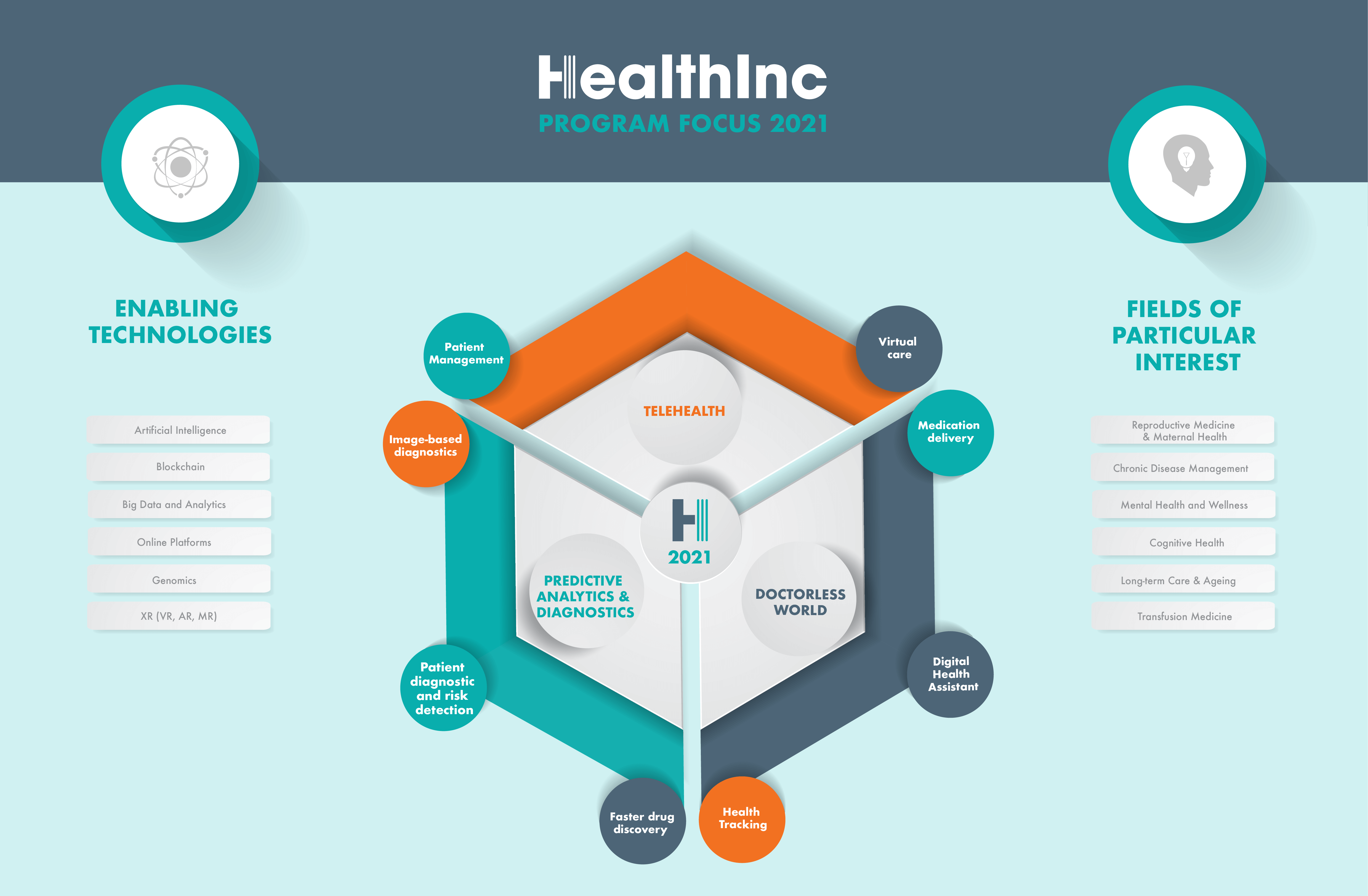
Carefully selected from more than 5000 startups all over the world, we have concluded the 13 healthtech startups to join HealthInc’s third accelerator program during our Selection Day on 2nd September 2021. These talented entrepreneurs cover various aspects of the healthtech industry, which mainly focus on three main areas: telehealth, doctorless world, and predictive analytics and diagnostics. Take a look here if you want to know more about the program.

HealthInc Accelerator Program Focused Areas

And now, time for the main event: The Third Official Class of HealthInc Accelerator Program.

Startups Participating

In alphabetical order:

  • BloodPORT: BloodPORT connects you to blood donors, blood banks, hospitals & events/camps nearby, instantly.
  • CureAssist: CureAssist is an AI-powered digital hospital.
  • DanAid: a Mutual Health Organization for the Cameroonians at home and from the diaspora.
  • GeminiLab: allows men to receive clinically approved sperm health reports without visiting a clinic.
  • Gleeworld Pharmacy: a subscription-based tele-pharmacy and medication delivery startup offering convenient access to affordable medicines with free delivery in 1 hour.
  • Health Innovation Hub: building a Personalised Health as a Service (PHaaS) platform offering individualized testing & health analysis to empower clients towards improved health.
  • Healers: A web and mobile-based application for facilitating home visits by doctors on weekends and non-office hours on weekdays.
  • Neo Childcare: A Digital Child Heath service provider bridging the gap of access to healthcare for children especially in Nigeria.
  • Neurotops: faster contact with psychotherapists, yet dramatically easier than ever before.
  • newGenia: newGenia is developing solutions to bring down the cost of genomic data analysis using secure and high-performance computing.
  • Qlear Analytics: helps pathologists detect and evaluate anatomic samples in 3D with its innovative second-reader digital pathology system.
  • Telemedicols: An intelligent software that analyzes CT / MRI / X-rays to detect and examine cancerous tumors
  • Zeus Care: a Mobile App in health with Artificial Intelligence and Big Data that connects patients with doctors and pharmacies in an easy and efficient way and where payments can be made through electronic means.

Coming up next

Continuing the success we had earlier, our third program will remain geographically accessible and lockdown-friendly. That means the program will again be completely online, allowing us to empower entrepreneurs in health and to innovate healthcare systems as we know. With the official cohort finally selected, the third program kicks off in September and finishes in January 2022 with the usual Demo Day.

Congratulations again to the selected teams!

Would you like to keep up with our news and updates? Sign up now for our Newsletter! 🙂

The post HealthInc’s Third Cohort: Get to know the selected startups! appeared first on Healthinc.

]]>
https://healthinc.io/blog/healthinc-third-cohort-of-startups/feed/ 0
Achieving global health is achieving SDGs. Here is how. https://healthinc.io/blog/global-health-and-sdgs-here-is-how/?utm_source=rss&utm_medium=rss&utm_campaign=global-health-and-sdgs-here-is-how https://healthinc.io/blog/global-health-and-sdgs-here-is-how/#respond Tue, 13 Jul 2021 12:59:59 +0000 https://healthinc.io/?p=1750 What are SDGs? In 2015 the United Nations created and established the 17 Sustainable Development Goals (SDGs), which act as a collection of goals designed to achieve a “better and more sustainable future for all”. Since its creation, 17 SDGs have been benchmarked as a universal guide in establishing a brighter tomorrow for humanity. Certainly […]

The post Achieving global health is achieving SDGs. Here is how. appeared first on Healthinc.

]]>
What are SDGs?

In 2015 the United Nations created and established the 17 Sustainable Development Goals (SDGs), which act as a collection of goals designed to achieve a “better and more sustainable future for all”. Since its creation, 17 SDGs have been benchmarked as a universal guide in establishing a brighter tomorrow for humanity. Certainly through this new lens, the achievement of global health is not to be dismissed and overlooked. Instead of asking “what can we do for you?” nations now realize the importance of collaborative efforts (COVID19 pandemic is a clear epitome), to work together to consider “what can we do together?” to solve common health challenges. 

Achieving Global Health as a part of the 17 Sustainable Development Goals

Aiming for 2030, the agenda for sustainable development emphasizes that achieving the SDGs requires balancing three dimensions of sustainable development: economic growth, social inclusion and environmental protection. What is influenced and interlinked with all three dimensions? Health. More specifically, the third goal aims to “Ensure healthy lives and promote well-being for all at all ages”.

What is the relation?

According to the World Health Organization (WHO), major challenges remain in terms of reducing maternal and child mortality and in the need to continue the fight against transmissible and chronic diseases, including their risk factors. There is a need to focus on these ongoing issues and to create solutions that can be implemented in healthcare on a global level. Solutions include implementing universal health coverage and financial risk protection, creating greater access to quality fundamental healthcare services and essential medicines and vaccines. So, how does health – more specifically digital health – play a part in all of this?

Digital health solutions have boosted the development to enhance medical communication, the efficiency of care, the management of chronic conditions, reducing costs and improving medical outcomes overall. Using digital health in relation to SDG 3 involves strengthening the capacity of all countries for early warning, risk reduction, and the management of national and global health risks. These advances in technology are enabling populations to push back the boundaries of disease.

Digital Health is one of the main focuses at HealthInc

Real-life examples

There are many healthtech game-changing entrepreneurs working tirelessly to shift the status quo, and we would like to shed light on some of the solutions our alumni startups are doing.

Enhanced Fertility with the use of AI, machine learning and predictive analytics is creating efficient diagnosis by rapidly detecting fertility risk factors, delivering personalized information and treatment recommendations, all whilst making global patient treatment pathways accessible to all. 

or

Amygdala Health, who is using digital health to manage and prevent chronic heart diseases all powered by behavioral science. According to the WHO, “cardiovascular diseases are the leading non-communicable disease, attributable to 17.9 million deaths globally per year”.

think also of 

Luci Health, as they are tackling everlasting and non-curable dementia (which affects 50 million people worldwide) using voice technology for shorter diagnosis and earlier detection.

The list goes on and on. Despite the changes we have seen and improvements we have made, more attention needs to be brought to realize the goals we have set for ourselves. Because our health is an investment and not an expense. For a better and more sustainable future for all.

Curious what our portfolio startups are up to? Get in touch with us for a more in-depth overview and partnership opportunities!

The post Achieving global health is achieving SDGs. Here is how. appeared first on Healthinc.

]]>
https://healthinc.io/blog/global-health-and-sdgs-here-is-how/feed/ 0
Big Data in Healthcare https://healthinc.io/blog/big-data-in-healthcare/?utm_source=rss&utm_medium=rss&utm_campaign=big-data-in-healthcare https://healthinc.io/blog/big-data-in-healthcare/#respond Thu, 25 Feb 2021 12:50:14 +0000 https://healthinc.io/?p=1377 Big Data is not an uncommon subject nowadays, just as AI, Machine Learning or Blockchain have been for the last few years. And although these concepts are well-discussed in consumer goods or FinTech, the impacts they can have in the healthtech landscape are often overlooked. We don’t want that, do we? With COVID-19 sweeping across […]

The post Big Data in Healthcare appeared first on Healthinc.

]]>
Big Data is not an uncommon subject nowadays, just as AI, Machine Learning or Blockchain have been for the last few years. And although these concepts are well-discussed in consumer goods or FinTech, the impacts they can have in the healthtech landscape are often overlooked. We don’t want that, do we? With COVID-19 sweeping across continents, it is time for us to pay more attention to the role of data in health and why collecting such information will allow us to have better and more personalized healthcare. Cheaper, faster, more accurate, that is how we want our treatments to be!

Wearable devices collect your personal health data, an example of data in health.

What exactly is Big Data?

‘Normal’ data is a collection of facts (numbers, words, measurements, observations, etc.) that has been translated into a form that computers can process. Data is everywhere: your age, your name, the dress you looked up yesterday, and certainly your test results from the clinic. Whichever industry interests you, data has already revolutionized it. The way that computers interpret data is different than how we as humans do. Data in computing and business refers to machine-readable information as opposed to human-readable information. That is structured data versus unstructured data. Big data is ‘a little’ different. It comprises more extensive, more complex data sets that traditional data processing software just can’t manage. Similarly, big data in health refers to consumer, patient, physical, and clinical data that is too vast or complex to be understood by traditional data processing. Instead, big data is often interpreted and analyzed by machine learning algorithms and data scientists. With digital transformation finally arriving in healthcare, the demand for big data to fuel data-driven decisions, minimize human errors and increase personalized therapeutics has grown larger and larger. Naturally, Big data in healthcare became a thing.

To visualize how big ‘big data’ in health is, here are some numbers: if all the digital healthcare data is stored on a stack of tablet computers, the height of the tower, by the year 2020, would cross 82,000 miles (or 131,966 km) – scaling from 5,500 miles (or 8,851 km) in 2013. For the record, the tallest tower right now does not even reach 1km in height.

Burj Khalifa – The tallest tower in the world standing at 828m, while the ‘digital healthcare data tower’ is estimated to cross 131,966 km in height.

Why is it such a big deal and why is everyone talking about it?

As mentioned before, big data is the premise for data-driven decision-making while minimizing human errors and most importantly, treating patients better and more efficiently. Data tracking and analysis in healthcare will change the world for the better. Not only that, with the massive amount of information at hand, data scientists can forecast upcoming epidemics and combat existing diseases while saving a significant amount of money. Not to mention, in terms of healthcare, investments are pouring into Big Data.

Projected value of big data investments in healthcare globally in 2018 and 2021 (in billion U.S. dollars)

For instance, a McKinsey report in 2011 indicates a high financial impact of big data applications in the healthcare domain in the US: the sector could create more than $300 billion in value every year, whereas two-thirds of that would be in the form of reducing expenditure. Similarly impressive numbers are provided by IBM: within the Executive Report of IBM Global Business Services (Korster and Seider 2010), the authors describe the healthcare system as highly inefficient: approximately US$ 2.5 trillion is wasted annually and efficiency can be improved by 35%.

But there is more to it.

Let’s look at some significant sources of Big Data in Healthcare:

  1. Electronic health record (EHR): test results, clinical observations, diagnoses, current health problems, medications taken by the patient, the procedures he/she underwent
  2. Personal health record (PHR): Allergies and adverse drug reactions, chronic diseases, family history, also illnesses and hospitalizations.
  3. Medical Images: the usual concepts of CT, MRI or X-ray that we always talk about. It just proves that Big Data has been around for longer than we are aware of.

And just how popular is it? A study done by Statista in 2018 showed 44% of US adult respondents had accessed their EHR, while 18% had not accessed them, but they did have one. Only 6% of respondents opted out of having an EHR.

Percentage of US adults that have accessed their electronic health records (EHR) as of 2018

Many startups saw this window of opportunity and did not disappoint. Among our portfolio companies, OncoChain creates an extensive database with real-world data about oncological patients to generate useful analytics that can guide and support research. They provide a web-based oncology EHR that also acts as a software platform that connects the patient with care providers.

Roadblocks and Obstacles

However, there is always a catch. Unlike other industries, healthcare is tightly secured with rules and regulations, which have fenced off innovations for change. The broad scope and diversity of big data applications showed just how valuable and promising this technology could improve overall healthcare delivery. To realize such potential seamless access to various health data sets is required, but it is minimal and cumbersome in reality.

How can we address this issue? Research in 2019 pointed out that several technical requirements such as semantic enrichment of data, data integration and sharing, data privacy and security, as well as data quality have to be addressed. In terms of market adoption, the big data revolution in the healthcare domain is in a very early stage with the most potential for value creation and business development unclaimed and unexplored. Current roadblocks are the healthcare system’s established system incentives, which hinder collaboration and, thus, data sharing and exchange. Like thousands of healthtech startups out there, OncoChain collaborates with large organizations to share data safely and securely. They are the unspoken heroes who will turn the wheel for humankind.

Would you like to keep up with our news and updates? Sign up now for our Newsletter! 🙂

The post Big Data in Healthcare appeared first on Healthinc.

]]>
https://healthinc.io/blog/big-data-in-healthcare/feed/ 0
How does the COVID-19 pandemic accelerate innovations in health? https://healthinc.io/blog/covid19-accelerate-innovations-health/?utm_source=rss&utm_medium=rss&utm_campaign=covid19-accelerate-innovations-health https://healthinc.io/blog/covid19-accelerate-innovations-health/#respond Tue, 16 Feb 2021 11:12:47 +0000 https://healthinc.io/?p=1428 It is impressive and heart-warming to see countries put their hands together and erase their borders to tackle the coronavirus’s sudden attack. We ought to reflect and learn our lessons as we brace ourselves for the second wave of surging cases. This pandemic has accelerated innovations at a mind-boggling speed, especially in health. We have […]

The post How does the COVID-19 pandemic accelerate innovations in health? appeared first on Healthinc.

]]>
It is impressive and heart-warming to see countries put their hands together and erase their borders to tackle the coronavirus’s sudden attack. We ought to reflect and learn our lessons as we brace ourselves for the second wave of surging cases. This pandemic has accelerated innovations at a mind-boggling speed, especially in health. We have adapted ourselves within months, which should have taken us decades in normal circumstances. In a time of dire need, we called for creative solutions and that was exactly what happened.

We can clearly see how much havoc COVID-19 has already wreaked. Globally, the pandemic was projected to dip most countries into recession with a historic contraction of per capita income and advanced economies are estimated to shrink remarkably. That was after the first wave back in April, while it is clear now the second wave is at the doorstep.

Wearable devices collect your personal health data, an example of data in health

It did not even take COVID-19 to realize the persisting problems of overly burdened healthcare workers, such as high demand, shortage of staff, or inefficient workflows and processes. The World Medical Association already warned us: nearly half of the world’s physicians experience symptoms of physical, mental, and emotional exhaustion, confirming the significantly high levels of stress and burnout. That was in 2018, two years before the dawning of the current pandemic. The only difference now is that there’s a need for greater efficiency and responsiveness more than ever before. The longer it persists, the more damage will be inflicted. The world needs change, and we need it fast.

So why is innovation so unsuccessful in health care?

To answer that, we must break down the problem, looking at the different types of innovation and the forces that affect them. There are three kinds of innovation that can make health care better and cheaper. The first one is consumer-focused, which has to do with the ways consumers buy and use health care. The second kind of innovation has to do with technology: developing new products and treatments or otherwise improving care. Finally, the third kind of innovation has to do with new business models, particularly those that involve horizontal or vertical integration of separate health care organizations or activities. The six forces — industry players, funding, public policy, technology, customers, and accountability — can either help or hinder innovation efforts. Individually or in combination, the forces will affect the three types of innovation in different ways. Not to mention, it is very likely that those who use a product or service are not those who pay for that product or service.

The Healthcare system differs from country to country, with legislators playing different roles in each. Only they can remove the barriers to health care innovation resulting from current laws and regulations.

There are three kinds of innovation that can make health care better and cheaper, and there are six forces that can either help or hinder these innovation efforts. Additionally, the Healthcare system differs from country to country.

How did COVID-19 change that?

These constraints really put creativity to work and have opened up a fresh avenue for innovations. A pearl of common wisdom suggests that compliance restrictions and a lack of resources are the main obstacles to innovation. Only by eradicating all constraints can creativity and innovative thinking thrive. But that is not necessarily true. 145 empirical studies on the effects of constraints on creativity and innovation found that individuals, teams, and organizations alike benefit from a healthy dose of limitations. It is only when the controls become too high that they stifle creativity and innovation.

Constraints provide focus and a creative challenge that motivates people to search for and connect information from different sources to generate novel ideas for new products, services, or business processes. In a few words, COVID-19 created a restrained environment that forced the world to bring out creativity and innovative thinking.

Constraints provide focus and a creative challenge that motivates people to search for and connect information from different sources to generate novel ideas.

Additionally, the pandemic united us all. Suddenly, we are fighting a common enemy. Everything had to change. Services went remote, new hospitals were built within days, and everybody stayed off the street in lockdowns for weeks to protect each other. Healthtech companies piled in to help with these unprecedented challenges and were welcomed with unusually open arms.

However, the most apparent change is the adoption of telehealth. “Two to seven percent of doctors were ready to offer video-consultations (prior to the pandemic), but now it’s closer to 60%,” said Dr. Gottfried Ludewig, Director of ‘Digitalisation and Innovation’, Federal Ministry of Health, Germany. The country’s contact tracing app called Corona Warn-App has seen about 17.5 million downloads and Dr. Ludewig noted that the app has a connection to laboratories that offer COVID-19 testing, which helps inform people much faster than before.

More proof?

During the pandemic, consumers have moved dramatically toward online channels, and companies and industries have responded in turn. The survey results confirm the rapid shift toward interacting with customers through digital channels. They also show that adoption rates are years ahead of where they were when previous surveys were conducted.

What kind of digital innovations sprouted during the time of the pandemic?

The most apparent one includes digital engagement, where care providers used remote patient engagement to communicate quickly at scale while keeping their staff and patients safe. Patient data exchange is another digital innovation for better and faster treatments when ICU beds run low. During the crisis, Philips collaborated with the Dutch government to create an online portal that supported Dutch hospitals in exchanging COVID-19 patient data. And there are many more!

Conclusion

The COVID-19 pandemic is only the catalyst that boosted the somewhat sluggish healthcare industry. Now that we have received more attention, we need to take full advantage of this opportunity and advance the industry forward. Capital investments in healthcare have already exceeded annual expectations. Fundings are pouring into digital health as it is set to be the largest year ever and we still have one more quarter to go. As entrepreneurs in health, we need to drive this surging wave and use this momentum to change healthcare for the better!

Glad you have made it this far, would you like to consume more of our healthtech-related content? Check out our blogs!

The post How does the COVID-19 pandemic accelerate innovations in health? appeared first on Healthinc.

]]>
https://healthinc.io/blog/covid19-accelerate-innovations-health/feed/ 0
Top 10 Startups HealthInc 2021 Announced https://healthinc.io/blog/top-10-startups-healthinc-2021/?utm_source=rss&utm_medium=rss&utm_campaign=top-10-startups-healthinc-2021 https://healthinc.io/blog/top-10-startups-healthinc-2021/#respond Fri, 29 Jan 2021 10:30:51 +0000 https://healthinc.io/?p=1442 Buckle up, HealthInc 2021 is ready to move! The top 10 finally emerged! From a pool of more than 3500 fantastic healthtech startups we interacted with, we have finally selected the top 10 to join HealthInc 2021 program during our Selection Day on 28th January 2021. These talented entrepreneurs cover various aspects of the healthtech […]

The post Top 10 Startups HealthInc 2021 Announced appeared first on Healthinc.

]]>
Buckle up, HealthInc 2021 is ready to move!

The top 10 finally emerged! From a pool of more than 3500 fantastic healthtech startups we interacted with, we have finally selected the top 10 to join HealthInc 2021 program during our Selection Day on 28th January 2021. These talented entrepreneurs cover various aspects of the healthtech industry, which mainly focus on three main areas: telehealth, doctorless world, and predictive analytics and diagnostics. Take a look here if you want to know more about the program!

HealthInc 2021 Accelerator Program Focused Areas

Due to the uncertain developments of COVID19 in the Netherlands, this year’s program will be fully online. With that, the startups can spend their time more flexibly according to their availability and make the most out of the resources that we will provide. This will be an incredible journey for all of them: intensive mentorship and training, masterclasses and hands-on workshops, 1-on-1s with experts and potential clients, and so much more.

And now, time for the main event. HealthInc 2021: Official Cohort Announced!

Startups Participating

In alphabetical order:

  • Afya Bora (Tanzania): A data-driven medical appointment scheduling platform and marketplace.
  • Amygdala Health (Estonia): A digital health program that helps you build healthy habits.
  • BioMinds (Poland): A new way for neurological rehabilitation.
  • Enhanced Fertility (UK): A digital program making fertility education, support and care accessible to all.
  • Kapsule (UK): A managed marketplace to revolutionize African medical supply chains.
  • Luci Health (Spain): A disruptive application platform through voice, which detects early-stage dementia markers and increases the patient’s longevity and quality of life.
  • Martixa (US): The Axela for healthcare.
  • Phamo (Cyprus): A pharmacy platform to match patients with compatible pharmacy goods.
  • ShareMed (Chile): A global and exclusive platform for health professionals to exchange knowledge in real-time.
  • Superpow (UK): An online platform where users can connect with a therapist who can help them overcome mental wellbeing challenges.

HealthInc 2021: What’s next?

Covid-19 was difficult and still is difficult to deal with. This year, our team has reflected and pivoted quickly into a lockdown-friendly accelerator program. HealthInc 2021, completely online, will allow us to empower even more entrepreneurs in health and innovate healthcare systems as we know. With the official cohort finally selected, the program will kick-off in February and finish in April with the usual Demo Day.

HealthInc 2021 Official Cohort

Congratulations again to the well-deserved teams. Buckle up because your HealthInc journey has just started!

Would you like to keep up with our news and updates? Sign up now for our Newsletter! 🙂

The post Top 10 Startups HealthInc 2021 Announced appeared first on Healthinc.

]]>
https://healthinc.io/blog/top-10-startups-healthinc-2021/feed/ 0
Join HealthInc and RVO in the Dutch Pavilion at GIANT Health! https://healthinc.io/blog/healthinc-and-rvo-at-giant-health/?utm_source=rss&utm_medium=rss&utm_campaign=healthinc-and-rvo-at-giant-health https://healthinc.io/blog/healthinc-and-rvo-at-giant-health/#respond Tue, 24 Nov 2020 15:27:11 +0000 https://healthinc.io/?p=1356 “The UK and Europe’s biggest healthcare technology festival” as referred by the Finance Times, GIANT Health Event 2020 is a virtual festival of healthtech innovation. This year, in collaboration with The Netherlands Enterprise Agency – RVO, we are going to GIANT Health and represent the Dutch healthtech startup ecosystem at our own Dutch Village virtual booth. […]

The post Join HealthInc and RVO in the Dutch Pavilion at GIANT Health! appeared first on Healthinc.

]]>
“The UK and Europe’s biggest healthcare technology festival” as referred by the Finance Times, GIANT Health Event 2020 is a virtual festival of healthtech innovation. This year, in collaboration with The Netherlands Enterprise Agency – RVO, we are going to GIANT Health and represent the Dutch healthtech startup ecosystem at our own Dutch Village virtual booth.

Startups in Health: Come and meet us at the Dutch Village!

As healthtech pioneers, GIANT Health not only offers you access to passionate European healthtech innovators but also gives way to directly interact with opportunities to learn and grow. And that is exactly why the Dutch Village we are hosting will allow us to search and scout for the best talents in healthtech for our hybrid Accelerator Program. In addition, our colleagues at RVO can guide you through how to set up your business in Amsterdam and the Netherlands in general. This could be especially interesting for startups and scale-ups, as RVO can help them in myriad ways!

Are you a startup in the digital health landscape? Do you tackle today’s health problems with technologies and innovations? We want to meet you. Grab your chance and talk to our team personally at GIANT Health.

What can you get from us?

  • Dutch startups can enjoy special perks when purchasing tickets through us: We have 10 delegate tickets plus a 5% discount for Dutch healthtech startups, so get in touch with us now at [email protected] or [email protected]!
  • International startups can learn more about what it is like to do business in the Netherlands and opportunities for funding and network with the help from RVO.

Who is RVO?

The Netherlands Enterprise Agency (RVO) helps startups and scale-ups find their way into the Dutch ecosystem. Do you need a coach to help you grow your business in the Netherlands and abroad? RVO is here for you, they offer government funding, advice, and an international economic network. Additionally, RVO helps enterprising Dutch people and policy staff move forward in the field of sustainability, doing business across borders, agricultural entrepreneurship and innovation.

What about GIANT Health?

GIANT Health is a significant event in healthtech landscape and you should consider joining. Here is why:

  • “The UK and Europe’s biggest healthcare technology festival” as referred by the Finance Times
  • GIANT Health has a forecast 50,000 passionate innovators at Europe’s greatest festival of health tech innovation
  • 75% of GIANT attendees are in senior positions: Company Directors, Head of Innovation, etc.
  • A two-day, high profile and international virtual festival of healthtech innovation. Starting on Tuesday 1 December at 8.30 until Wednesday 2 December 19.30 GMT
  • This year event will be held virtually and will be accessible to all four corners of the globe

In short, join HealthInc and RVO in the Dutch Pavilion at GIANT Health! Get in touch with us now at [email protected] or [email protected] for special offers!

The post Join HealthInc and RVO in the Dutch Pavilion at GIANT Health! appeared first on Healthinc.

]]>
https://healthinc.io/blog/healthinc-and-rvo-at-giant-health/feed/ 0
Who are Intrapreneurs in Residence and why are they important? https://healthinc.io/blog/intrapreneurs-in-residence/?utm_source=rss&utm_medium=rss&utm_campaign=intrapreneurs-in-residence Tue, 14 Jul 2020 13:46:06 +0000 http://healthinc.local/who-are-intrapreneurs-in-residence-and-why-are-they-important/ No it is not a typo. It is 'Intrapreneurs in Residence'. Yes the term 'Entrepreneurs in Residence' or 'EIRs' is more familiar. EIRs are people who build bridges into the startup community. At HealthInc, the EIRs connect our cohort to the health-tech experts and offer them insights of a seasoned entrepreneur.

The post Who are Intrapreneurs in Residence and why are they important? appeared first on Healthinc.

]]>
Intrapreneurs and Entrepreneurs in Residence

No it is not a typo. It is ‘Intrapreneurs in Residence’. Yes the term ‘Entrepreneurs in Residence’ or ‘EIRs’ is more familiar. EIRs are people who build bridges into the startup community. At HealthInc, the EIRs connect our cohort to the health-tech experts and offer them insights of a seasoned entrepreneur. Despite their essential roles in the journey to success of a startup, Intrapreneurs in Residence are not as popular compared to their co-stars EIRs. The main difference here is that one comes from a startup background and the other is from a corporate environment. In this blog, we will give the spotlight to our corporate representatives: The Intrapreneurs in Residence or IIRs.

Corporate and Startup Collaboration

We all marvel, admire, and celebrate the rich history of Rome. We also appreciate the relationships of startup and corporate in the modern-day. But what do they have in common? They were never built in one day.

Corporate and Startup Collaboration takes time and involves many stages and people. But it is definitely rewarding. At HealthInc, such a role that consolidates this sort of rapport is none other than IIRs. Often, the term comes up in conversations about corporate and startup collaboration. Corporations need the innovation that startups offer, and startups lack the resources corporations possess. Although it is a win-win situation, getting in touch with the right startup or corporation can be rather challenging. Here is where IIRs come in.

HealthInc’s version of Intrapreneurs in Residence

Our IIRs are entrepreneurial individuals. They come from large corporations whose goal is to identify the technologies that their corporations might be interested in. At the same time, their long tenure in the corporate world helps IIRs to offer startups valuable guidance in so many aspects. Being full of innovations and ideas, you can imagine that startups often lack the right knowledge and approach to work with large corporations. In short, IIRs focus on picking the right startups, connecting them with the right persons and guiding them in the right direction.

What does an IIR do? Who are IIRs? While we enjoy a short break between our programs, let’s discover what IIRs can offer to startups, whether it is leveraging their value propositions or connecting with corporations. Take a look at the infographic below!

Hungry for more insights and HealthInc news? Visit our blogs archive and subscribe to our Newsletters!

The post Who are Intrapreneurs in Residence and why are they important? appeared first on Healthinc.

]]>
HealthInc Demo Day 2020: Filling the Healthcare Gaps https://healthinc.io/blog/healthinc-demo-day-2020-filling-the-healthcare-gaps/?utm_source=rss&utm_medium=rss&utm_campaign=healthinc-demo-day-2020-filling-the-healthcare-gaps Tue, 30 Jun 2020 12:27:46 +0000 http://healthinc.local/healthinc-demo-day-2020-filling-the-healthcare-gaps/ HealthInc Online Demo Day 2020 When we talk about basic needs, we talk food, we talk water, and we talk health. It is with these fundamental elements that begins a healthy life. The past months situation has proven that changes in healthcare must happen, and it must happen now. The successful Demo Day organized virtually […]

The post HealthInc Demo Day 2020: Filling the Healthcare Gaps appeared first on Healthinc.

]]>

HealthInc Online Demo Day 2020

When we talk about basic needs, we talk food, we talk water, and we talk health. It is with these fundamental elements that begins a healthy life. The past months situation has proven that changes in healthcare must happen, and it must happen now.

The successful Demo Day organized virtually last week has contributed to this cause. We brought nine talented startups that we selected all over the world and accelerated them during the program. They are now ready to shine!

The journey of nine startups at HealthInc

It is incredible to imagine that the program started just this February, which seemed like half a decade ago. First, we launched our HealthInc accelerator program. With that, we kick-started the mission to fill the gaps in the healthcare industry. From 1300 applications, more than 200 one-on-ones with international startups in 15 cities around the world, to HealthInc’s first class of 2020: nine talented and wholesome startups. They are:

  1. AIDA Diagnostics: Help make the best possible decision in blood management.
  2. Akila Labs: an AI-powered preventive health platform with its proprietary behavior data that will fundamentally alter healthcare business models while delivering unique products and services to its customers.
  3. ApexQubit: provides next-generation proprietary cloud software to automate a design of protein-based therapeutics.
  4. Easylabs: Lab results interpretation platform in multiple languages and from multiple perspectives.
  5. LumaWomb: Uses infrared light to thicken endometrial lining, helping to improve fertility due to an increase in child-bearing age in women worldwide.
  6. MedicPad: Manage patients intake process and medical records using cloud-based software.
  7. MiiCare: AI-based assistive technology for the elderly and people with needs.
  8. OncoChain: Builds an innovative blockchain platform to facilitate real world data collection and patient-centered care.
  9. Purple Gaze: Eye-tracking solutions.
HealthInc Class of 2020 at Selection Days in January

For the past four months the nine startups, Entrepreneurs and Intrapreneurs in Residence, and the HealthInc team worked hard with the support of our mentors and partners to make the acceleration program possible. And then, Covid19 forced us to transform into a digital program, nevertheless, we managed that smoothly.

Finally Demo Day itself!

Startups networking at HealthInc Online Demo Day 2020

Here we were: on the 24th of June, celebrated the end of the program with a big Demo Day!

Virtually, more than 100 people participated and witnessed the change in the making. They are mentors, investors, potential clients. More importantly, we have partners coming to support us, those who have made our HealthInc Accelerator Program possible: ahti, founders of startupbootcamp, Ferring Pharmaceuticals, Cordaan, Sanquin, City of Amsterdam, Innovation Exchange Amsterdam, and Amsterdam Medical Center.

The energy was high. We transpired an inspiring atmosphere, and conveyed a positive message: there are always good things to consider, and that these innovations our cohort presented will bring us the future!

You can revisit the live stream here:

This was the end of an accelerator journey for our first cohort, but it is just a start for many more to come. Stay tuned, another journey is promised to bring you the future: new cohort, new challenges, and of course new innovations!

The post HealthInc Demo Day 2020: Filling the Healthcare Gaps appeared first on Healthinc.

]]>
A message of hope from NYC-based startup during Coronavirus https://healthinc.io/blog/message-hope-nyc-startup/?utm_source=rss&utm_medium=rss&utm_campaign=message-hope-nyc-startup Tue, 21 Apr 2020 12:41:02 +0000 http://healthinc.local/a-message-of-hope-from-nyc-based-startup-during-coronavirus/ Ten days into April and the Coronavirus pandemic has shown no signs of stopping: despite strong measures from organizations, tireless medical staff efforts, and researchers working on novel vaccines. Prakash Hosalli – Akila Labs’ CEO, a participating startup in HealthInc’s program, is stuck with a dilemma. He came to Amsterdam last February as one of […]

The post A message of hope from NYC-based startup during Coronavirus appeared first on Healthinc.

]]>
Ten days into April and the Coronavirus pandemic has shown no signs of stopping: despite strong measures from organizations, tireless medical staff efforts, and researchers working on novel vaccines. Prakash Hosalli – Akila Labs’ CEO, a participating startup in HealthInc’s program, is stuck with a dilemma. He came to Amsterdam last February as one of the startups that got chosen in our Selection Days to commence the process of accelerating his startup. With the Coronavirus came storming in, he has no choice but to stay put, leaving his family back in New York City – now is the new epicenter after China’s Wuhan. We sat down, digitally we might add, to check up on Prakash, making sure he is holding up in these difficult times.

The Interview

1. The dilemma

– If I understand correctly, you are a NY based company. What is more important is that you have all of your family members there. Among our HealthInc cohort, you are the only one who is sandwiched in this dilemma: can’t go to work, but also can’t go back to your family. How does this affect you?

Prakash: It affects all of us in different ways, from fear of the unknown to anxiety caused by separation. The situation in New York has deteriorated very quickly and the spread of the pandemic has been faster and far more devastating than ever. At the moment of this article, there are already more than 100,000 cases with more than 10,000 casualties in NYC alone.

– How are your family doing? I hope they are all well?

Prakash: Luckily for us, our family is doing well. My wife, Lakshmi and our two sons took the threat very seriously and started following instructions for social distancing almost immediately. They have exercised a lot of caution and have shown remarkable maturity.

– What a relief to hear! In terms of the regulations and measures taken against the virus, how well do you think the US government is handling the situation?

Prakash: There’s no doubt that the response of the US government at the Federal level has been appalling. That said, The response of a lot of local and state-level governments has been exemplary, especially that of Governor Andrew Cuomo of New York. Monday 13 April he said that the state is controlling the spread and the worst is over if they continue to be smart and not do something reckless. 

2. The challenges

– How does being located/stuck in Amsterdam at the moment feel when your family and your business are in NYC?

Prakash: We made the decision to stay put wherever we were and take social distancing seriously. Air travel has been the primary source of the rapid spread of the disease. A few weeks back, Europe was the center of the pandemic and I could have aided the spread and endangered my family and other New Yorkers, had I traveled back. Here’s a report on how most COVID19 cases in New York came from Europe. I had also visited Milan in the 2nd week of Feb. In the absence of any testing, I was not sure if I was infected. 

– In your case it is indeed a clever decision: to stay put and practice serious social distancing. We would like to address the challenges at the moment and how do you deal with it?

The biggest challenge is to keep everyone in good spirits. It’s not easy to be positive when the news, especially in New York is so grim. We deal with it by communicating constantly and being open. We have developed coping mechanisms to keep the balance between optimism and reality. Having a sense of humor that all of us have to a certain degree helps. Everyone in our family is a great cook and spending time in the Kitchen has been very helpful.

a-message-of-hope-from-Akila-labs
“Startup will have to dig deep to find the resiliency to sustain through this crisis, and eventually come out stronger” – Prakash Hosalli

3. Prakash and his startup are moving forward

– How do you keep conducting business? Or is there no business at all?

There’s been no major impact on our ability to conduct business. We were a virtual company to begin with and we’ve operated without a formal office since the beginning. Our team is spread across 4 countries (USA, Netherlands, Australia and Portugal) and we have turned the art of collaboration into science! We have a very strong and mature team who feed off each other’s strength and we’re busier than ever.

– That is fortunate! What would you do (differently) if you were there? What are you doing now?

As I’d have been homebound in New York, I can be as effective as I can to contribute to the well being and health of New Yorkers and others from Amsterdam. Our focus now is to figure out the best and the fastest way to use our technology to address the current crisis and be prepared to aid people when the situation returns to the new “normal”. 

– What do you recommend to other startups?

I think this is a test for all of us and the future will depend on how each one of us copes with this crisis. This is especially true for Startups that will have to dig deep to find the resiliency to sustain through this crisis, and eventually come out stronger. 

We’re also best equipped to deal in an environment with fewer resources. This requires a lot of creativity and innovation to solve some really huge problems in the coming years. It’ll not be easy, but we didn’t become Entrepreneurs to do what’s easy. I wish everyone all the best – stay safe and healthy!

A message of hope

Yes. it is indeed a message of hope from our team at HealthInc, from Akila and Prakash himself, as well as our startup community: stay resilient to sustain through the crisis, and eventually come out as a unity, stronger and more prepared than ever before! Let this video put a smile on your face, and brighten your day as we fight the virus away 🙂


The post A message of hope from NYC-based startup during Coronavirus appeared first on Healthinc.

]]>